In a career that lasts more than one season, every player has a contract, a role and a weekly wage. Managing them well is the difference between a squad that grows and one that walks out of the door. This guide covers everything about contracts and money.
Contracts and roles
Each player's contract runs for a number of seasons. When it ends, he leaves for free. Each player also has a role: crucial, important, rotation, squad player or prospect. The role is a promise about playing time, and it affects both the wage he asks for and how much another club will want to pay for him.
Renewing a contract
Open Squad and then the Contracts tab. Players are grouped by when their deals end: this season, next season, and longer. Tap Renew on a player, choose his role and the number of seasons, and he tells you his wage demand straight away. The demand is already filled in. Offer it and he signs, as long as it fits your wage budget.
What players will and will not accept
- A good player will not accept a small role. Offer him more playing time or he will refuse.
- Older players only sign short deals. Past thirty-two, expect one or two seasons at most.
- Only players aged twenty-one or under can be signed as prospects.
- A player who signed recently cannot renegotiate yet.
Wages and the wage budget
Outside auction mode, every club has a weekly wage budget. Auctions have no weekly wages or wage allocation. Your wage bill is what you actually pay every week. A new signing or a renewal can only go through if the wage bill stays within the budget. The Contracts tab shows the bill, the budget and how much room is left.
Splitting your money
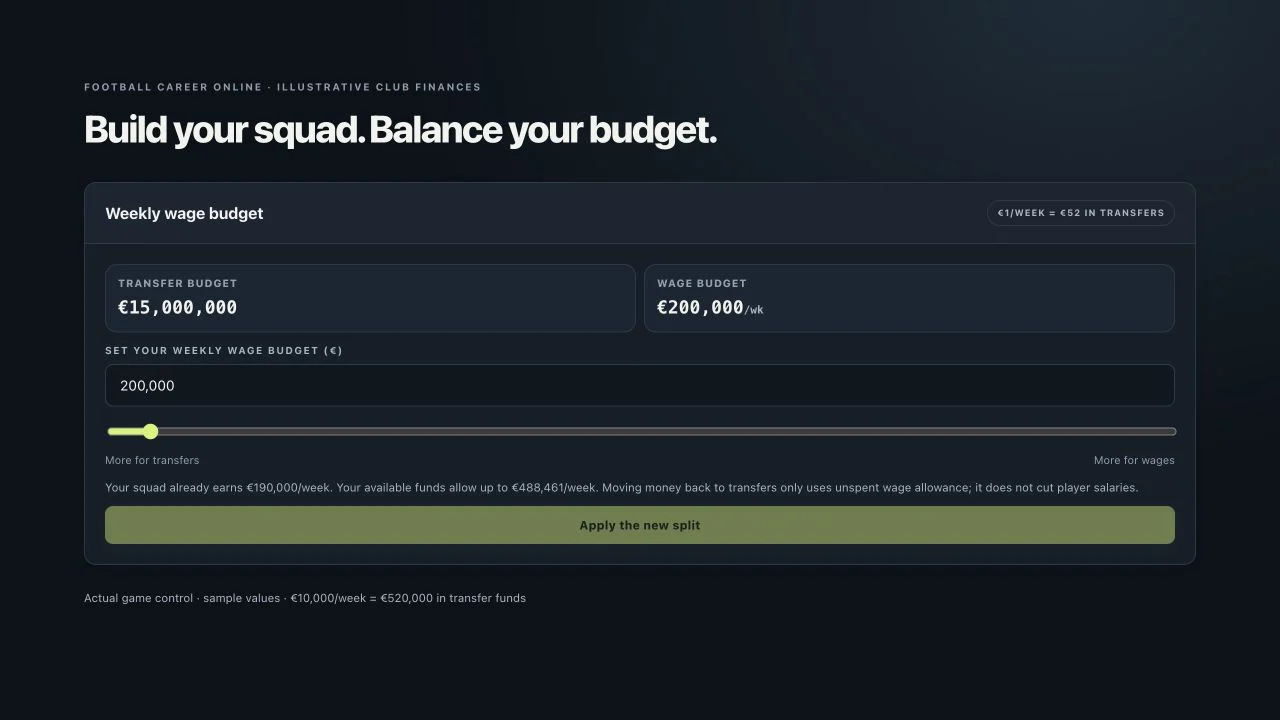
Transfer budget and wage budget are not fixed. Under Weekly wage budget in Squad or Transfers, type an exact amount or move the slider to reallocate money. One euro a week of wages is worth fifty-two euros in transfers, in either direction, so the total is always preserved. The wage budget can never go below what you already pay.
When to move money which way:
- More to wages when you want to keep stars, renew several players or sign someone on big wages.
- More to transfers when your wage bill is comfortable and you want to buy.
Expiring contracts
Outside auction mode, at the end of each season any player whose contract has ended leaves on a free transfer. The game warns you in several places: a badge on the Contracts tab, a reminder on the home screen and a list on the end-of-season panel. Read them.
Selling before a contract runs out
A player with a year left is worth less than one with four years left, because he can leave for nothing soon. If you do not plan to renew someone, selling him a season early often gets you a fee instead of nothing.
Prize money
At the end of each season clubs receive prize money depending on where they finished. It lands in your transfer budget for the next season, so a strong finish is also an investment.
Planning a squad across seasons
Players age. Most improve into their mid-twenties, hold their level for a few years and then decline. Past thirty-two the decline speeds up, and eventually players retire. A squad full of thirty-year-olds can win a title this season and fall apart the next.
A healthy squad has a spread of ages: a few experienced players for now, a core in their mid-twenties, and young players who will be your starters in two or three seasons. When you renew contracts, think about where each player will be at the end of the new deal, not just where he is today.
- Long deals suit young players who are improving: you lock in their wage before they get better.
- Short deals suit veterans: you keep them for a season or two without paying them as they decline.
- Selling at the peak is often smart. A twenty-nine-year-old at his best is worth far more now than in three years.
Balancing the books
A bloated squad consumes wage allowance even when half the players never play. Before the season starts, look at who earns the most and plays the least. Selling or releasing one expensive squad player can free enough wage room to sign a starter.
A season-end checklist
- Renew every player you want to keep before the season ends.
- Decide who you are happy to let go for free.
- Check the wage room for next season's signings.
- Rebalance transfer and wage budgets if needed.
Move €520,000 without losing track of it
Your transfer budget is €15,000,000, weekly wage allowance €200,000 and current wage bill €190,000.
- Raising the allowance to €210,000 costs €10,000 × 52 = €520,000 in transfer funds.
- The resulting transfer budget is €14,480,000 and wage headroom is €20,000 per week.
- Moving the allowance down to €190,000 instead releases €520,000, but leaves no headroom. You cannot lower it below the current wage bill.
What to take away: This is a conversion between two budget allowances. Auction careers skip the wage system entirely.
Further reading
- The Bosman ruling ↗The 1995 court case that lets players leave for free when their contract ends.
- Salary caps ↗How leagues limit wages, and why a wage budget matters.